 how-to
7 Ways to Track Metabolic Health Markers Daily
Last Updated: November 5, 2026
Quick Summary
To track metabolic health markers daily, measure fasting glucose and blood pressure on waking, post-meal glucose 60 to 90 minutes after your largest meal, and log sleep, steps and meals midday. Measure waist circumference weekly and review weekly averages each Sunday rather than single readings.
- A workable daily routine runs about six to eight minutes on a normal day.
- Start with two markers, not five, and add one only after a month of consistency.
- Take two blood pressure readings one minute apart and average them.
- Measure waist circumference at the navel after exhaling, once a week.
- Judge the week's average rather than the day's reading for any daily marker.
Table of Contents
- What to Measure: The Markers of Metabolic Health That Move Daily
- Daily Blood Glucose Tracking: Fasting, Post-Meal, and CGM Options
- A Step-by-Step Daily Tracking Routine You Can Keep
- Setting Up a Metabolic Health Tracking Journal
- Measurement Protocols and Sources of Error
- When to Get a Metabolic Health Test: Daily Signals vs. Periodic Labs
- Build Your Baseline With a Protocol That Fits Your Life
- Frequently Asked Questions
What to Measure: The Markers of Metabolic Health That Move Daily
How to track metabolic health markers daily starts with knowing which numbers actually change from one day to the next. Metabolic health markers are the measurable signals, such as blood glucose, blood pressure, and waist circumference, that show how well your body turns food into energy.
Five markers matter most for daily tracking:
- Fasting glucose, your blood sugar before eating
- Post-meal glucose, the rise and fall after food
- Blood pressure, both numbers
- Waist circumference, measured at the navel
- Triglycerides and HDL cholesterol, which move slowly and belong in periodic lab work
The first four respond to yesterday's meals, sleep, and movement. For a deeper walkthrough, see how to reverse insulin resistance step by step. The last two barely budge in a week. That split shapes every routine below.
Daily Blood Glucose Tracking: Fasting, Post-Meal, and CGM Options
Daily blood glucose tracking gives you the fastest feedback of any marker. A fingerstick meter costs little and takes seconds. Test fasting glucose right after waking, then again 60 to 90 minutes after your largest meal.
A continuous glucose monitor, or CGM, reads interstitial glucose every few minutes through a small sensor on the arm. It shows patterns a single fingerstick cannot. The trade-off is cost and a learning curve.
Whichever tool you choose, log the number and the context together. A reading of 110 means one thing after a poor night's sleep and another after a brisk walk.
A Step-by-Step Daily Tracking Routine You Can Keep
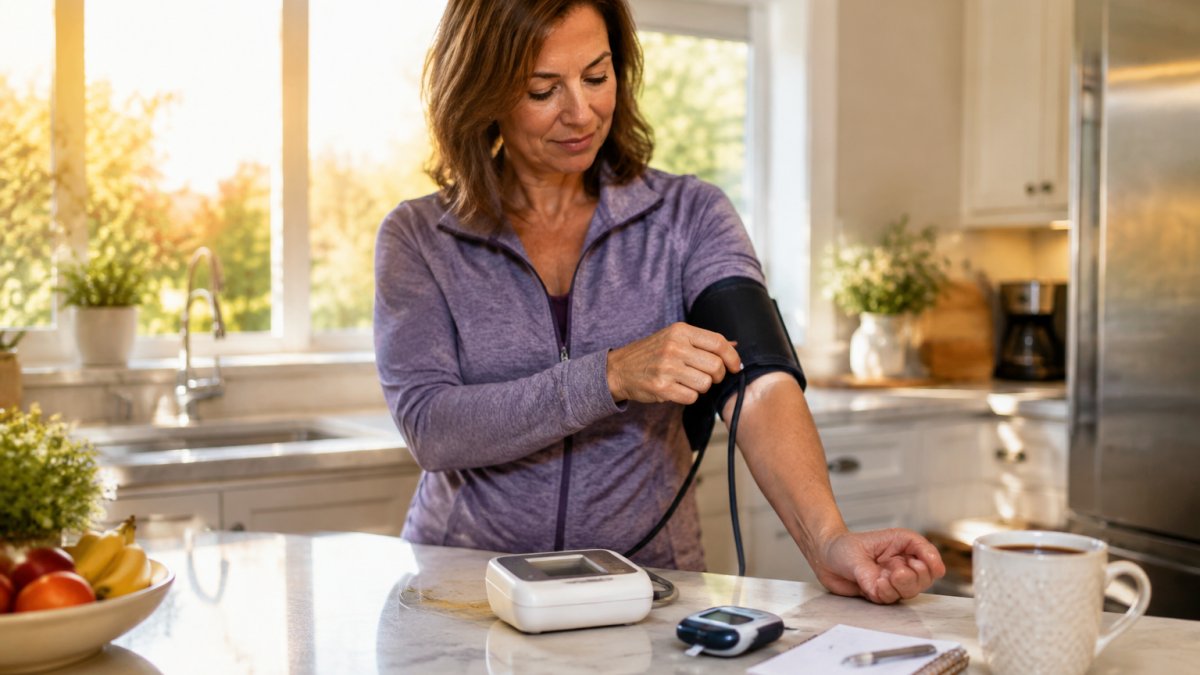
Most guides tell you which markers matter and stop there. The gap is the workflow: what to record, when, and how long it actually takes. A workable daily routine runs about six to eight minutes on a normal day and about fifteen minutes once a week. Here is the sequence, with the reasoning behind each step.
On waking, before food or coffee (about 3 minutes). Measure fasting glucose first, then blood pressure. Fasting glucose is most comparable when it is taken after at least eight hours without calories, so keep the timing consistent day to day. Blood pressure belongs here too because the morning reading, taken seated and quiet, is the one most practitioners use to spot a trend. Record both numbers plus the time.
After your largest meal (about 1 minute). Check post-meal glucose at the 60-to-90-minute mark. The exact minute matters less than using the same window each day; a reading at 60 minutes and a reading at 90 minutes are not interchangeable. Note what you ate and roughly how much.
Midday (about 1 minute). Log sleep hours from the night before, step count so far, and a one-line meal description. These are the context variables that explain glucose swings later.
Once a week, not daily (about 5 minutes). Measure waist circumference at the navel after exhaling, and record weight if you track it. Waist and weight move too slowly to justify daily measurement, and daily readings add noise without information.
Sunday review (about 10 minutes). Look at weekly averages and trend direction rather than single readings. A single 140 mg/dL post-meal reading is not a crisis; a two-week pattern of readings above your usual range is worth a conversation with a clinician.
A simple daily log can be five columns: date and time, marker, value, context (sleep, meal, exercise), and a short note. Paper works; a spreadsheet makes the Sunday review faster because you can chart the week.
Start with two markers, not five. Most people who quit try to measure everything on day one. Add a marker only after the first two have been consistent for a month.
Watch out: if you take blood pressure medication, do not change the timing of your readings without telling your clinician, because the reading is partly a measure of when the dose was taken.
Here is the daily sequence, with what to record and how long each step takes.
| When | What to do | Time |
|---|---|---|
| On waking, before food or coffee | Measure fasting glucose, then blood pressure; record both numbers plus time | About 3 minutes |
| After largest meal | Check post-meal glucose at the 60-to-90-minute mark; note meal and amount | About 1 minute |
| Midday | Log sleep hours, step count so far, and a one-line meal description | About 1 minute |
| Once a week, not daily | Measure waist circumference at the navel after exhaling; record weight if tracked | About 5 minutes |
| Sunday review | Look at weekly averages and trend direction rather than single readings | About 10 minutes |
Setting Up a Metabolic Health Tracking Journal
A metabolic health tracking journal is a simple log that pairs each reading with the behavior behind it. Paper works. A spreadsheet works better for trend analysis.
Build your journal with these columns:
- Date and time
- Marker and value
- Sleep hours
- Meal size and timing
- Exercise type and duration
- Notes on stress or illness
The notes column is where the value hides. A common mistake is recording numbers without context, then wondering why glucose spiked. Nine times out of ten, the answer sits in the notes from the night before.
Measurement Protocols and Sources of Error
Protocol errors wreck more tracking data than bad devices. The fix is to standardize the conditions, not to buy better equipment. Below are the protocols that matter most, the common errors that distort each one, and how to average readings so a single bad measurement does not derail your trend.
Fasting glucose. Wash and dry hands before every fingerstick; food residue on a fingertip can push a reading falsely high. Use the same fingerstick meter and the same morning window. Take one reading; if it looks far off your recent pattern, take a second and average the two. Fasting glucose can run higher on mornings after poor sleep or late meals, which is why the context note matters as much as the number.
Post-meal glucose. Use the same time window each day (60 or 90 minutes, not both). Note the meal size and composition, because a high-carbohydrate meal and a high-protein meal produce different curves. Do not compare a post-meal reading to a fasting reading; they answer different questions.
Blood pressure. Sit quietly for five minutes before measuring, back supported, feet flat on the floor, arm at heart level, cuff on bare skin. A reading taken over clothing or with dangling feet can run high. Take two readings one minute apart and average them. Measure at the same time each day, because blood pressure follows a daily rhythm.
Waist circumference. Measure at the navel, after exhaling, with the tape snug but not compressing the skin. Measuring at the wrong spot or over clothing adds or subtracts inches. Measure once a week, at the same time of day, and record the number rather than rounding.
Wearable data. Step count and sleep hours are useful context, but they are estimates, not clinical measurements. Treat them as trend lines, not as precise values, and do not compare one device's numbers to another's.
Averaging and trends. For any marker you measure daily, judge the week's average rather than the day's reading. A single outlier is usually a protocol slip or a bad night's sleep; a two-week shift in the average is the signal worth acting on.
Reference ranges versus your baseline. General reference ranges are population guides, not personal targets. Your baseline, built from two quiet weeks of consistent measurement, is the comparison that matters most. A reading inside the general range can still be unusual for you, and a reading slightly outside it can be normal for you. That distinction is why a clinician interprets your numbers alongside your log rather than in isolation.
If you want to see how the formulas behind these protocols are built, the research behind the formulas is organized by body system with published studies cited.
Watch out: no home device replaces a diagnosis. If readings run persistently high or low, or you feel dizzy, faint, or unusually thirsty, contact a clinician rather than adjusting anything yourself.
When to Get a Metabolic Health Test: Daily Signals vs. Periodic Labs
Daily tracking shows patterns. A metabolic health test through comprehensive bloodwork shows the full picture, including triglycerides, HDL cholesterol, and long-term health markers that daily tools cannot read.
Daily signals tell you what to ask about. Labs tell you where you stand. Bring your journal to the appointment; a month of glucose trends is more useful to a clinician than a single fasting draw. If you are weighing whether labs are worth the cost, our breakdown of whether metabolic health testing is worth it covers what each test actually reveals.
Watch out: no home device replaces a diagnosis. If your readings run persistently high or low, or you feel dizzy, faint, or unusually thirsty, contact a clinician rather than adjusting anything yourself.
Build Your Baseline With a Protocol That Fits Your Life
Your baseline is the average of two quiet weeks of tracking, not one good morning. Once you have it, change one input at a time and watch the trend lines for 14 days before judging the result.
For readers who want structured support alongside their tracking, our metabolic weight management protocol is formulated by Dr. Paulette Y. Jones, DNP-L, RN, who has nearly thirty years of clinical nursing experience. Ingredients and doses appear in full on the label.
Track first. Then choose what supports the numbers you see.
Frequently Asked Questions
Which metabolic health markers can I measure daily?
You can reasonably measure four things at home each day: fasting blood glucose with a meter or continuous glucose monitor, blood pressure with a validated cuff, waist circumference with a tape measure, and body weight. Triglycerides and HDL cholesterol require a blood draw, so those belong in periodic lab work rather than a daily routine. Tracking the daily four gives you trend data between lab visits, which is where most of the useful signal lives.
How often should I check blood glucose for metabolic health?
If you use a fingerstick meter, one fasting reading each morning plus one reading 60 to 90 minutes after your largest meal covers the basics. A continuous glucose monitor records interstitial glucose every few minutes, so you review the data rather than prick your finger. Consistency matters more than volume: the same time, same conditions, and same meal timing each day makes the numbers comparable week to week.
What should I record in a metabolic health tracking journal?
Log the measurement itself, the time, and the conditions: hours slept, whether you exercised, meal size and timing, and any stress or illness. Note the units and which device you used. Add a short trend note once a week, such as whether fasting glucose drifted up or down. The conditions column is what turns a pile of numbers into something you can interpret, because it shows what changed when a marker moved.
How do I know if my at-home readings are accurate?
Check your blood pressure cuff against a reading taken at a clinic, and follow the protocol: sit quietly for five minutes, feet flat, arm at heart level, no caffeine or exercise for 30 minutes prior. For glucose meters, test your control solution when you open a new strip vial. Waist circumference is easiest to get wrong, so measure at the same landmark, usually just above the hip bone, with the tape snug and level, and take two readings.
The hardest part of tracking is not the measuring. It is staying with it long enough for patterns to appear. N&O LLC builds phased herbal protocols with full ingredient transparency, research-based formulations, and the clinical perspective of a doctoral-prepared nurse behind every formula. Get started with N&O LLC and give your daily numbers something consistent to work with.