 listicle
Herbal Supplements for Cellular Health: 2026 Guide
Table of Contents
- What Cellular Health Means for Your Energy and Longevity
- How to Improve Cellular Energy Naturally
- Herbs for Mitochondrial Support
- Best Supplements for Nerve Discomfort Relief
- Choosing Quality Herbal Supplements for Cellular Health
- Common Mistakes to Avoid
- Frequently Asked Questions
Last Updated: September 28, 2026
What Cellular Health Means for Your Energy and Longevity
Cellular health is the ability of your cells to produce energy, repair damage, and maintain balance over time. When mitochondria, the tiny power plants inside each cell, lose efficiency, you feel it as fatigue, brain fog, and slower recovery. This guide breaks down how herbal supplements for cellular health fit into that picture.
Every symptom you associate with aging, from aching nerves to stubborn weight gain, traces back to cells that are running at reduced capacity.
Mitochondria: Your Cellular Power Plants
Mitochondria convert nutrients into ATP, the energy currency every cell spends. Fewer working mitochondria means less ATP, and less ATP means your nerves, muscles, and brain operate on a smaller budget.
How to Improve Cellular Energy Naturally
The most effective way to improve cellular energy naturally is to combine consistent movement, sleep, and targeted nutrient intake rather than chasing one miracle ingredient. Exercise triggers a process called mitochondrial biogenesis, where your body builds new mitochondria in response to demand.
- Move daily: Even brisk walking signals your cells to expand energy capacity.
- Protect sleep: Deep sleep is when most cellular repair happens.
- Eat whole foods: Colorful vegetables supply antioxidants that limit free radicals.
- Manage stress: Chronic stress raises inflammation markers that damage cells.
- Target key nutrients: Magnesium, B vitamins, and CoQ10 support ATP production directly.
Herbs for Mitochondrial Support
The herbs most studied for mitochondrial support include ashwagandha, rhodiola, and curcumin, each working through a different mechanism. Ashwagandha helps the body manage stress that otherwise drains cellular resources. Rhodiola supports stamina under physical and mental load. Curcumin provides antioxidant protection that limits oxidative stress.
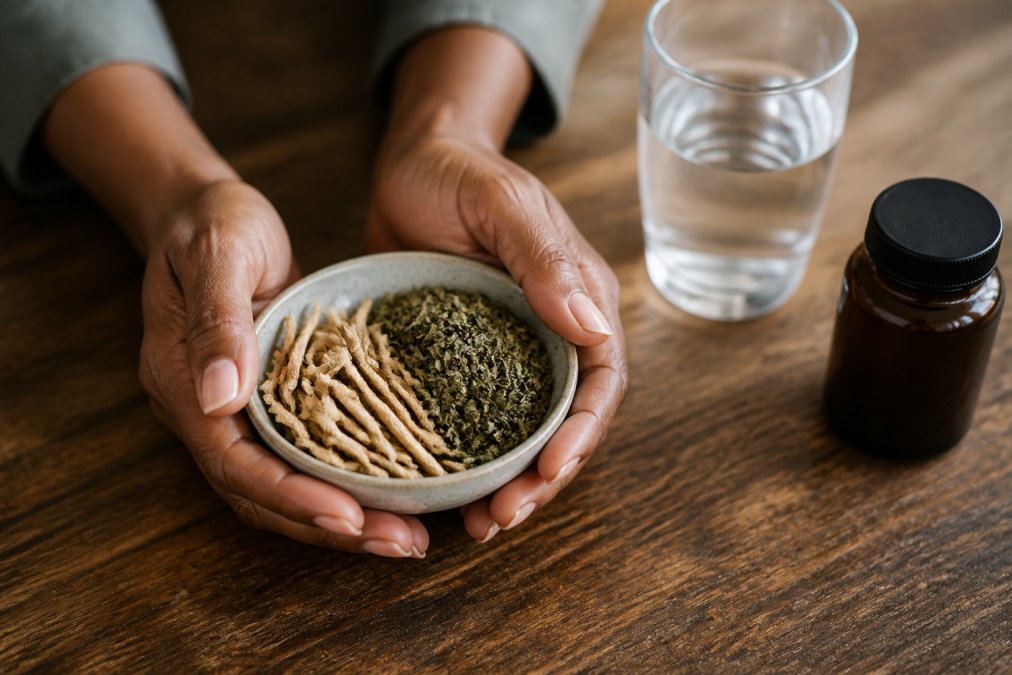
- Ashwagandha (Withania somnifera): The active constituents are withanolides, typically standardized to 5% or more. It works primarily through the HPA axis, blunting the cortisol response that otherwise pulls resources away from repair. Most studied doses fall in the 300-600 mg per day range of a standardized root extract.
- Rhodiola rosea: The actives are rosavins and salidroside, commonly standardized to 3% rosavins and 1% salidroside. It modulates stress-response pathways and supports fatty acid oxidation, which is one reason it is associated with stamina under load. Typical studied doses are 200-600 mg per day.
- Curcumin (from Curcuma longa): The parent compound has notoriously poor oral absorption. Standardized extracts use piperine, phospholipid delivery, or tetrahydrocurcumin forms to raise blood levels. It acts on NF-κB and Nrf2 pathways, which sit at the intersection of inflammation and the cell's own antioxidant response.
- CoQ10 (ubiquinone or ubiquinol): Not an herb, but the most direct mitochondrial cofactor on this list. It carries electrons in the electron transport chain. Ubiquinol is the reduced, more absorbable form; ubiquinone is cheaper and fine for many people but requires conversion.
- Alpha-lipoic acid and acetyl-L-carnitine: Frequently paired in the literature because they support mitochondrial membrane function and fatty acid transport into the mitochondria, respectively. They are often discussed together rather than in isolation.
Why Form and Timing Change the Outcome
This is the part most listicles skip. A nutrient your cells cannot absorb is money spent for nothing. Curcumin taken as plain powder is largely excreted; the same dose in a phospholipid or piperine-enhanced form produces measurably higher plasma levels. CoQ10 is fat-soluble, so taking it with a meal containing fat improves absorption compared with an empty stomach. Rhodiola and ashwagandha are typically taken earlier in the day because their stress-modulating effects can feel activating for some people.
Stacking: What Works Together and What Competes
Nutrient synergy runs in both directions. Some combinations multiply benefits; others compete for the same absorption pathways.
- Works well together: CoQ10 with a fat-containing meal; curcumin with piperine or phospholipids; magnesium with B6; alpha-lipoic acid with acetyl-L-carnitine.
- Competes for absorption: High-dose zinc and copper, calcium and iron, and multiple high-dose minerals taken at the same time. Separate them by a few hours.
- Timing conflicts: Fat-soluble nutrients (CoQ10, curcumin, vitamin D) belong with meals; water-soluble B vitamins are fine any time but can be stimulating late in the day.
Here is how the leading options compare:
| Product | Key Focus | Starting Price | Best For |
|---|---|---|---|
| N&O LLC | Nerve, metabolic, and cellular recovery | See site | Phased herbal protocols |
| Life Extension CoQ10 | ATP production | $28.00 | Cellular energy support |
| New Chapter Ashwagandha | Stress resilience | $24.99 | Stress management |
| Life Extension Curcumin Elite | Inflammation and antioxidant support | $32.00 | Systemic protection |
| Purovitalis NMN | NAD+ and DNA repair | $65.00 | Healthy aging |
Best Supplements for Nerve Discomfort Relief
The best supplements for nerve discomfort relief address both nerve protection and the underlying cellular environment. Magnesium supports nerve signaling, curcumin calms inflammatory pathways, and B vitamins help maintain the myelin sheath around nerves.
Choosing Quality Herbal Supplements for Cellular Health
Choosing quality herbal supplements for cellular health comes down to three things: ingredient form, dose transparency, and third-party testing. A label that hides behind a "proprietary blend" tells you nothing about whether the product contains a meaningful dose.
What to Look For on a Label
- Named extracts with percentages: "Standardized to 80% silymarin" beats "milk thistle extract."
- Bioavailability enhancements: Fermented herbs and phospholipid forms absorb better.
- Exact doses per ingredient: You cannot evaluate a formula without them.
- Third-party test results: Heavy metal and purity testing separates serious brands from the rest.
- A clear serving size: Vague dosing makes consistency impossible.
The Bioavailability Gap Most Guides Ignore
Bioavailability is the gap topic most articles skip. A nutrient your body cannot absorb is money spent for nothing, which is why delivery format matters as much as the ingredient list. The NIH Office of Dietary Supplements fact sheets explain how absorption varies widely between forms of the same nutrient.
The clearest examples are worth memorizing:
- Methylated vs. synthetic B vitamins: Folate as methylfolate and B12 as methylcobalamin are already in the form the body uses. Synthetic folic acid requires enzymatic conversion, and a meaningful share of people carry a variant that makes that conversion inefficient.
- Curcumin: Plain powder is poorly absorbed. Piperine, phospholipid, or tetrahydrocurcumin forms raise plasma levels substantially.
- CoQ10: Ubiquinol is the reduced form and is better absorbed than ubiquinone for many people, particularly over 40.
- Magnesium: Oxide is cheap and poorly absorbed; glycinate, citrate, and malate are better tolerated and better absorbed.
- Iron: Heme iron absorbs more efficiently than non-heme, but non-heme with vitamin C closes much of the gap.
Age-Specific Cellular Needs
This is the second gap most guides miss. A person in their twenties optimizing focus has different priorities than someone in their sixties managing metabolic health, and the protocol should reflect that.
- 20s and 30s (prevention): The goal is protecting mitochondrial capacity before it declines. Antioxidant support, adequate magnesium and B vitamins, and consistent exercise that drives mitochondrial biogenesis matter more than exotic compounds.
- 40s and 50s (transition): NAD+ levels begin a more noticeable decline, and recovery slows. CoQ10, curcumin, and adaptogens become more relevant, and sleep quality starts to matter as much as any supplement.
- 60s and beyond (repair and longevity): The focus shifts toward repair, inflammation control, and maintaining muscle and nerve function. CoQ10, curcumin, magnesium, and B12 (absorption declines with age) tend to move to the front of the list.
Dietary vs. Supplemental Intake
Supplements are meant to fill gaps, not replace food. A food-first approach looks like this: get antioxidants from colorful vegetables and fruit, get magnesium from leafy greens, nuts, and seeds, and get omega-3s from fatty fish. Then use supplements to cover what your diet and your stage of life leave short. The FDA guidance on dietary supplements reminds consumers that supplements are regulated differently from medications, which is why label scrutiny matters.
Common Mistakes to Avoid
The biggest mistake is stacking supplements without a plan. Nutrient synergy works both ways: the right combination multiplies benefits, while a random pile of capsules wastes money and can cause interactions.
- Chasing single ingredients: Cells need broad-spectrum support, not one hero nutrient.
- Ignoring age-specific needs: NAD+ declines with age, so needs shift over time.
- Skipping the basics: No supplement replaces sleep, movement, and whole foods.
- Buying on price alone: Cheap formulas often underdose the active ingredient.
- Stopping too soon: Herbal protocols build gradually and need weeks of consistency.
Frequently Asked Questions
What is the best supplement for cellular health?
There is no single best supplement; it depends on your needs. For cellular energy, CoQ10 supports mitochondrial function. For antioxidant protection, curcumin and milk thistle help manage oxidative stress. For nerve discomfort, magnesium and adaptogens like ashwagandha may help. A formula combining multiple herbs often works better than a single ingredient because nutrients work together. Look for third-party testing and transparent labeling.
How do herbal supplements impact metabolic health at the cellular level?
Herbal supplements can influence metabolic health by supporting mitochondrial function, reducing oxidative stress, and helping maintain healthy inflammation markers. For example, berberine and curcumin have been studied for their effects on cellular energy and insulin sensitivity. Adaptogens like rhodiola may help the body manage stress, which affects metabolic balance. These effects are gradual and work best alongside a healthy diet and exercise.
Can herbal supplements improve mitochondrial function?
Some herbs and nutrients show promise for mitochondrial support. CoQ10 is a well-researched compound that aids ATP production. Alpha-lipoic acid and acetyl-L-carnitine also support mitochondrial health. Herbal adaptogens like ashwagandha and rhodiola may help protect mitochondria from stress. However, no supplement can replace fundamental habits like regular movement, adequate sleep, and a nutrient-rich diet.
Are there FDA-regulated standards for cellular health supplements?
The FDA regulates dietary supplements under a different set of rules than medications. Manufacturers are responsible for ensuring safety and labeling accuracy, but the FDA does not approve supplements before they are sold. Third-party certifications like USP, NSF, or ConsumerLab can help verify quality. Always choose products from companies that provide certificates of analysis and follow good manufacturing practices.