 blog
7 Best Natural Nootropics for Focus and Memory
Table of Contents
- Why Natural Nootropics Are Worth a Closer Look
- Quick Comparison: 7 Best Natural Nootropics for Focus and Memory
- 1. Bacopa monnieri: The Memory Standard
- 2. Lion's Mane Mushroom: Nerve Growth and Mental Clarity
- 3. L-Theanine: Calm Focus Without the Crash
- 4. Rhodiola rosea: Stress, Fatigue, and Alertness
- 5. Ginkgo biloba: Blood Flow and Cognitive Function
- 6. Citicoline: Attention and Brain Energy
- 7. American Ginseng: Alertness and Mood
- How to Choose a Nootropic Supplement
- Natural Nootropic Side Effects and Safety
- Frequently Asked Questions
Last Updated: October 14, 2026
Why Natural Nootropics Are Worth a Closer Look
Natural nootropics are plant- and nutrient-based compounds taken to support focus, memory, and mental clarity without a prescription. Interest in them keeps climbing as more adults look for gentler ways to sharpen attention and protect long-term brain health. At N&O LLC, we field questions daily from people who want to think more clearly but feel uneasy about stimulant-heavy products.
The honest starting point: no single pill fixes a foggy brain. What works is a small set of well-studied ingredients, taken at the right dose, for the right reason, over enough weeks to matter.
Below, we break down the seven best natural nootropics for focus and memory, explain what the evidence actually supports, and flag the safety details most guides skip. Our selection method was simple: an ingredient made the list only if it has human research behind it, a clear use case, and a track record of safe use at standard doses.
NIH Office of Dietary Supplements botanical fact sheets
Quick Comparison: 7 Best Natural Nootropics for Focus and Memory
Here is the short version before the detail. Each ingredient below earns its place for a specific job, not as an all-purpose brain pill.
| Ingredient | Primary Benefit | Typical Daily Dose | Time to Effect | Best For |
|---|---|---|---|---|
| Bacopa monnieri | Memory and learning | 300 mg standardized | 8-12 weeks | Long-term recall |
| Lion's mane | Mental clarity, nerve support | 500-1,000 mg | 4-8 weeks | Brain fog |
| L-theanine | Calm focus | 100-200 mg | 30-60 minutes | Focus without jitters |
| Rhodiola rosea | Stress and fatigue | 200-400 mg | Days to 2 weeks | Burnout, low energy |
| Ginkgo biloba | Blood flow, cognition | 120-240 mg | 4-6 weeks | Age-related decline |
| Citicoline | Attention, brain energy | 250-500 mg | 1-2 weeks | Sustained attention |
| American ginseng | Alertness, mood | 200-400 mg | 1-2 weeks | Afternoon slumps |
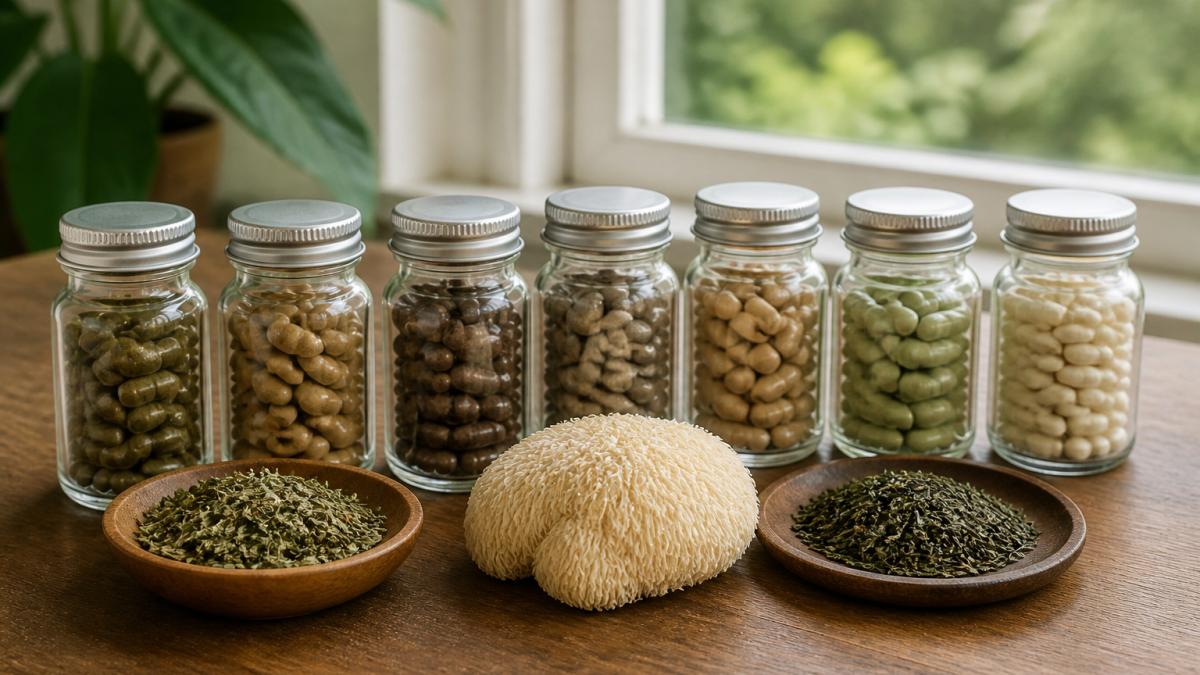
1. Bacopa monnieri: The Memory Standard
Bacopa monnieri is the ingredient with the deepest human evidence base on this list, and it is also the slowest. That combination is why it anchors the memory category rather than the focus category.
What the evidence actually shows. Bacopa has been tested in multiple randomized, placebo-controlled human trials, most of them in healthy adults over 8 to 12 weeks. The consistent pattern is a modest improvement in delayed recall and learning rate, not a dramatic jump. In practical terms, most people who respond describe remembering names, lists, and where they left things a little more easily. They do not describe a sudden sharpening of attention.
Evidence grade: Strong for memory and learning in healthy adults; weak for acute focus.
Realistic effect size: Small to moderate. Expect incremental gains over weeks, not a step change.
How to take it. Standardized extracts are typically dosed at 300 mg daily, taken with food. Standardization matters here: look for a label that states the percentage of bacosides, the active compound class, rather than just "Bacopa extract." Taking it with a meal that contains some fat improves absorption and reduces the stomach upset that trips people up in the first two weeks.
Timing and time to effect. Take it once daily, morning or evening. Benefits build over 8 to 12 weeks. There is no meaningful acute effect, so do not judge it after a week.
Where it falls short. Loose stools, mild nausea, and occasional fatigue are the most reported side effects, usually in the first weeks. Bacopa is not a fast fix, and anyone hoping to feel sharper by tomorrow will be disappointed. It also does not appear to help acute focus, so pairing it with L-theanine or citicoline is a common approach for people who want both memory support and same-day alertness.
Who it is best for. Adults focused on long-term recall and learning who are willing to commit to a 2- to 3-month trial.
2. Lion's Mane Mushroom: Nerve Growth and Mental Clarity
Lion's mane is a culinary mushroom studied for its compounds that support nerve health. People most often reach for it when brain fog, not outright memory loss, is the problem. Results build gradually over four to eight weeks.
Dose and form: Extracts are commonly dosed at 500 to 1,000 mg daily. Fruiting-body extracts are preferred over mycelium-on-grain powders, which can be mostly filler.
The catch: Much of the excitement comes from lab and animal work. Human evidence is promising but smaller, so treat lion's mane as supportive rather than proven.
National Center for Complementary and Integrative Health
3. L-Theanine: Calm Focus Without the Crash
L-theanine is an amino acid found in green tea, and it is the closest thing to an instant result on this list. Taken alone, it promotes relaxed alertness within an hour. Paired with caffeine, it smooths out the jitters that caffeine alone can cause.
Typical dose: 100 to 200 mg, as needed. Effects appear in 30 to 60 minutes, making it easy to time around deep work.
Reality check: L-theanine supports focus. It does not boost memory on its own, so do not expect it to carry that load.
4. Rhodiola rosea: Stress, Fatigue, and Alertness
Rhodiola is an adaptogen, meaning it helps the body handle stress rather than stimulating it directly. For people whose focus problems trace back to burnout or exhaustion, it often helps more than a stimulant would.
Dose and timing: 200 to 400 mg of a standardized extract, usually in the morning. Taking it late can interfere with sleep.
Watch for: Rhodiola can feel activating. Start low, and skip it if you are prone to anxiety until you know how you respond.
5. Ginkgo biloba: Blood Flow and Cognitive Function
Ginkgo has been studied for decades for circulation and cognitive function, particularly in older adults. It is one of the better-known natural nootropics, though results are modest and build over four to six weeks.
Standard dose: 120 to 240 mg daily of a standardized extract.
Safety note: Ginkgo can increase bleeding risk. Anyone on blood thinners should talk to a clinician before starting it.
6. Citicoline: Attention and Brain Energy
Citicoline supports the brain's energy metabolism and attention. It is popular among people in their 30s and 40s who want steadier focus during long work sessions, with effects often noticeable within one to two weeks.
Dose: 250 to 500 mg daily.
Why it stands out: Unlike most herbs here, citicoline has a clearer mechanism tied to brain cell energy, which is why it shows up in so many focus-focused formulas.
7. American Ginseng: Alertness and Mood
American ginseng rounds out the list as a gentle option for alertness and mood, especially for the afternoon slump. Doses of 200 to 400 mg are common, with effects appearing within one to two weeks.
The trade-off: Quality varies widely between brands, so a standardized extract matters more here than with almost any other ingredient on this list.
FDA guidance on dietary supplement labeling
How to Choose a Nootropic Supplement
Choosing well comes down to reading the label like an auditor, not a shopper. Most of the information you need is right there, or conspicuously missing.
1. Standardization. A standardized extract guarantees a consistent amount of the active compound from batch to batch. The label should name the compound and its percentage, not just the herb. "Bacopa extract" tells you nothing.
2. Full dose disclosure. Every ingredient and its amount should be listed. A "proprietary blend" that hides individual doses is a product you cannot evaluate, because you cannot tell whether the effective ingredient is present at a meaningful dose or at a token sprinkle.
3. Third-party testing. A certificate of analysis (COA) from an independent lab confirms identity, potency, and absence of contaminants. Look for testing by an established lab, and ask the manufacturer for the COA if it is not published.
4. Serving size and servings per container. A label can list an impressive-sounding dose per serving while the container holds only a few servings, or vice versa.
5. Form and bioavailability. Fruiting-body extracts are generally preferred over mycelium-on-grain powders for lion's mane. Standardized extracts are preferred for Bacopa, Rhodiola, Ginkgo, and ginseng. For citicoline, the common forms are generally well absorbed.
6. Ingredient-to-goal match. Memory points to Bacopa. Same-day focus points to L-theanine. Sustained attention points to citicoline. Stress-related fatigue points to Rhodiola.
7. Single ingredients vs. blends. Single-ingredient products let you isolate what works and what causes side effects. Blends are convenient but make it impossible to trace a reaction or adjust a dose. If you are new to nootropics, start with single ingredients and build from there.
This is where transparency separates good products from marketing. At N&O LLC, our formulations list every ingredient and dose on the label, built on research-based herbal protocols and nearly thirty years of clinical nursing experience behind them.
Natural Nootropic Side Effects and Safety
Most natural nootropics are well tolerated at standard doses, but "natural" does not mean risk-free. Bacopa can upset digestion. Rhodiola can feel overstimulating. Ginkgo and American ginseng can interact with blood thinners, diabetes medications, and blood pressure drugs.
If you take prescription medication, are pregnant or nursing, or manage a chronic condition, talk with your clinician before adding any supplement. Bring the actual bottle so they can read the doses.
Frequently Asked Questions
Do nootropics actually work?
Natural nootropics work differently depending on the ingredient and the outcome measured. Bacopa monnieri has the most consistent memory evidence, with trials showing improvements after 8-12 weeks of daily use. L-theanine paired with caffeine improves attention within 30-60 minutes. Rhodiola rosea reduces fatigue under stress. Effects are usually modest, not dramatic, and they work best alongside sleep, exercise, and good nutrition. Anyone expecting a prescription-level boost from a botanical will be disappointed.
How long do natural nootropics take to work?
Timing depends on the ingredient. L-theanine and caffeine produce effects within 30-60 minutes. Rhodiola rosea and American ginseng often show acute benefits within 1-2 hours. Bacopa monnieri and lion's mane mushroom are slower, typically requiring 4-12 weeks of consistent daily use before memory or clarity changes appear. Citicoline falls in the middle, with attention benefits reported after 2-4 weeks. Match your expectations to the ingredient, not the marketing.
Are natural nootropics safe to take every day?
Most well-studied natural nootropics are safe for daily use at standard doses in healthy adults. Bacopa monnieri may cause mild digestive upset in some people. Rhodiola rosea can feel stimulating if taken late in the day. Ginkgo biloba and American ginseng can interact with blood thinners and diabetes medications. Anyone taking prescription drugs, pregnant, nursing, or managing a chronic condition should talk to their doctor before starting a daily nootropic routine.
What should I look for when choosing a natural nootropic?
Check four things. First, standardized extracts with the active compound percentage listed, such as bacosides in Bacopa or rosavins in Rhodiola. Second, third-party testing for purity and potency. Third, a full ingredient list with doses, not a vague proprietary blend. Fourth, a dose that matches what clinical trials used. A transparent label with real numbers tells you more than a long ingredient list with hidden amounts.
Focus and memory support works best when the ingredients are real, the doses are honest, and the plan matches your actual goal. That is the standard we build to at N&O LLC. Our supplements are formulated by Dr. Paulette Y. Jones, DNP-L, RN, with fully transparent ingredient and dose labels and phased protocols designed for gentle, steady progress. Get started with N&O LLC and build a brain health routine you can actually trust.