 blog
Best Professional Grade Nerve Health Supplements
Table of Contents
- What Makes Professional Grade Nerve Health Supplements Different
- Vitamins for Nerve Health: Essential Micronutrients for Nervous System Support
- Alpha-Lipoic Acid for Neuropathy: Research, Dosage, and Evidence
- Supplements for Diabetic Neuropathy: Targeted Support for Blood Sugar-Related Nerve Damage
- Nerve Supplement Ingredients and Safety: What to Know Before You Buy
- How to Choose the Right Professional Grade Nerve Health Supplement for Your Needs
- Frequently Asked Questions
Last Updated: October 11, 2026
What Makes Professional Grade Nerve Health Supplements Different
Professional grade nerve health supplements stand apart through rigorous formulation standards, transparent ingredient disclosure, and research-backed protocols. At N&O LLC, we develop formulations that bridge clinical expertise with natural botanical support.
Nerve health requires targeted micronutrient support. Mass-market supplements often rely on generic blends without dosing precision or evidence-based ingredient selection. Professional formulations specify exact amounts, bioavailable forms, and complementary compounds that work synergistically to address nerve-related concerns.
Vitamins for Nerve Health: Essential Micronutrients for Nervous System Support
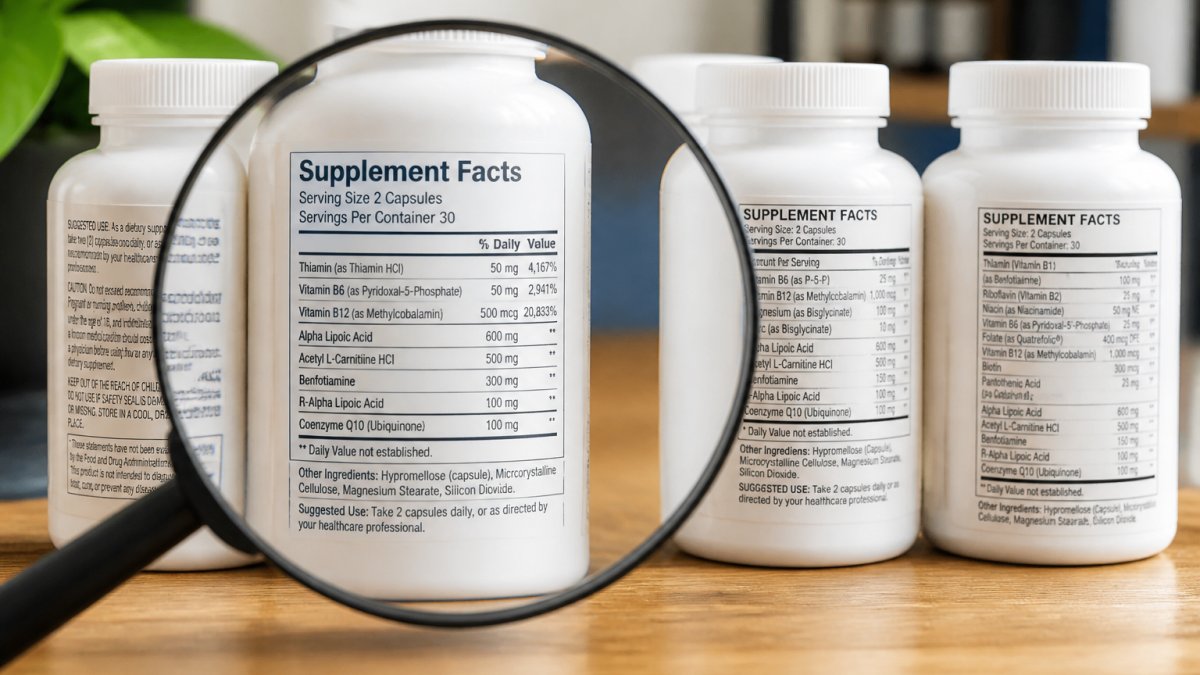
B-complex vitamins form the foundation of nerve health support, playing irreplaceable roles in myelin formation, neurotransmitter synthesis, and cellular energy production, and are among the most researched micronutrients for neuropathic support.
B-Complex Vitamins and Thiamine
Thiamine (vitamin B1) is essential for nerve impulse transmission and energy metabolism in nerve cells.
Benfotiamine, a fat-soluble form of thiamine, offers superior bioavailability and crosses the blood-brain barrier more effectively than standard thiamine hydrochloride.
B2, B3, B5, and B6 work alongside thiamine to support energy production and reduce oxidative stress in nerve cells.
Vitamin B12 and Methylcobalamin
B12 deficiency causes neuropathy, making B12 status critical for nerve concerns. Methylcobalamin, the active coenzyme form, is preferred in professional supplements.
Cyanocobalamin, the synthetic form in many commercial supplements, must be converted to methylcobalamin, a process that becomes less efficient with age.
Alpha-Lipoic Acid for Neuropathy: Research, Dosage, and Evidence
Alpha-lipoic acid is a naturally produced antioxidant that protects nerve cells from oxidative damage.
Research on alpha-lipoic acid focuses on doses of 300-600 mg daily, taken consistently over weeks to months.
Alpha-lipoic acid works in both water and fat environments, reaching nerve tissue throughout your body and supporting mitochondrial function, the energy-producing centers of nerve cells.
Supplements for Diabetic Neuropathy: Targeted Support for Blood Sugar-Related Nerve Damage
Diabetic neuropathy develops when elevated blood sugar damages nerve fibers through oxidative stress, inflammation, and impaired nerve cell energy production.
Professional formulations for diabetic neuropathy combine alpha-lipoic acid with benfotiamine and methylcobalamin.
Benefits typically emerge over 8-12 weeks of consistent use, making adherence and proper dosing critical.
Nerve Supplement Ingredients and Safety: What to Know Before You Buy
Choosing a professional grade nerve health supplement requires understanding ingredient interactions, appropriate dosing, safety considerations, and what quality verification actually protects you.
What Professional-Grade Quality Verification Means
The term "professional-grade" has no legal definition under FDA oversight.
Common third-party testing organizations include NSF International, USP (United States Pharmacopeia), and ConsumerLab.com. Products bearing their seals have undergone independent verification.
Manufacturing Standards and GMP Certification
Good Manufacturing Practice (GMP) certification establishes baseline standards for supplement manufacturing: facility cleanliness, equipment calibration, personnel training, and record-keeping. However, GMP compliance is self-certified by manufacturers; the FDA does not pre-approve supplements before sale.
Some manufacturers pursue NSF GMP or third-party GMP audits, providing external verification that facilities meet or exceed FDA standards.
When reviewing a supplement, ask whether the manufacturer has third-party GMP certification or publishes their quality control protocols.
Acetyl-L-Carnitine and Magnesium
Acetyl-L-carnitine supports nerve cell energy production by facilitating fatty acid transport into mitochondria.
Magnesium regulates neurotransmitter release, supports myelin formation, and reduces inflammatory responses in nerve tissue.
Medication Interactions and Condition-Specific Cautions
Before starting any nerve health supplement, discuss your current medications with your healthcare provider.
Individuals with multiple sclerosis, chemotherapy-induced neuropathy, or other specific conditions should verify that supplement ingredients won't interfere with their treatment protocols.
How to Choose the Right Professional Grade Nerve Health Supplement for Your Needs
Selecting an appropriate formula depends on your specific situation: the cause of your nerve concerns, other health conditions, current medications, and your health goals.
Evidence Grading by Ingredient and Dose
Promising but less established:
-
Acetyl-L-carnitine for neuropathy: Some studies show benefit at 2-3 grams daily over 12 weeks, particularly for diabetic neuropathy. However, evidence is mixed and less robust than for alpha-lipoic acid. It is a reasonable addition to a formula but should not be your primary ingredient if strong evidence is your priority.
-
Magnesium for nerve health: Magnesium is essential for nerve function, and deficiency impairs it. However, clinical trials specifically testing magnesium supplementation for neuropathy are limited. Magnesium is best viewed as foundational support rather than a primary treatment ingredient.
-
R-alpha-lipoic acid (the active form of alpha-lipoic acid): Some research suggests R-alpha-lipoic acid may be more bioavailable than the racemic mixture (R- and S- combined). However, direct comparative trials in humans are limited. If a formula specifies R-alpha-lipoic acid, it reflects attention to bioavailability, but the practical difference in neuropathy outcomes is not yet clearly established.
Matching Your Situation to the Right Formula
Diabetic neuropathy: Prioritize formulas containing alpha-lipoic acid (300-600 mg daily) and benfotiamine (150-300 mg daily). These two ingredients have the strongest evidence for blood-sugar-related nerve damage. A 12-week course is a reasonable starting point.
B12-deficiency neuropathy: If your healthcare provider has confirmed B12 deficiency, methylcobalamin supplementation (1000-2000 mcg daily) is evidence-based. However, this requires a confirmed deficiency; methylcobalamin does not help if your B12 status is normal.
Age-related nerve decline or general nerve support: For this broader category, a formula combining B-complex vitamins (including methylcobalamin and benfotiamine), alpha-lipoic acid, magnesium, and acetyl-L-carnitine provides multi-pathway support. Evidence for each ingredient individually is moderate, but the combination addresses multiple mechanisms of age-related nerve decline.
Medication-induced neuropathy (e.g., from chemotherapy or antiretrovirals): Evidence is limited for any single supplement. Alpha-lipoic acid and acetyl-L-carnitine have shown some promise in small studies. Discuss with your oncologist or prescribing physician before starting any supplement, as some may interact with your treatment.
Cost, Serving Size, and Value Over a Studied Course
Comparing supplements by bottle price alone is misleading. What matters is the cost per effective daily dose over the duration of treatment that research supports.
Selection Checklist
| Selection Factor | What to Evaluate | Why It Matters |
|---|---|---|
| Ingredient transparency | Full dose disclosure on label | You can verify alignment with studied doses |
| Evidence grading | Clear distinction between strong and preliminary evidence | Helps you assess realistic expectations |
| Bioavailable forms | Methylcobalamin, benfotiamine, glycinate, R-alpha-lipoic acid | Ensures your body can actually use the nutrients |
| Third-party testing | Verification of purity, potency, and contaminants | Confirms what's on the label is actually in the bottle |
| Studied duration | Recommended course length aligned with clinical trials | Guides realistic timeline for results |
| Cost per studied dose | Price to complete a full evidence-based course | Reveals true value vs. bottle price |
| Practitioner background | Clinical credentials and formulation rationale | Reflects depth of expertise and evidence-based thinking |
Timeline and Realistic Expectations
Nerve health improvements typically take 8-12 weeks of consistent supplementation at studied doses. This is not a quick-fix situation; it is a commitment to sustained cellular support.
If you do not see improvement after 12 weeks at the studied dose, discuss with your healthcare provider whether the formula is appropriate for your specific situation or whether a different approach is needed.
Frequently Asked Questions
What should I look for in a professional-grade nerve health supplement?
Look for supplements with clinically studied ingredients like alpha-lipoic acid, B-complex vitamins, acetyl-L-carnitine, and magnesium in therapeutic doses. Check that the label lists exact ingredient amounts, manufacturing standards (GMP certification), and third-party testing verification. Professional-grade supplements prioritize ingredient transparency and evidence-based formulations over filler ingredients. Verify the brand has clinical expertise behind the product, not just marketing claims.
Can supplements help with diabetic neuropathy?
Research suggests certain supplements may support nerve function in diabetic neuropathy. However, supplements work best alongside blood sugar management and medical treatment. Always discuss any supplement regimen with your healthcare provider, as they can interact with diabetes medications and affect blood sugar levels.
Are nerve health supplements safe to take with medications?
Many nerve health supplements are safe with medications, but some can interact. If you take blood thinners, diabetes medications, or other prescriptions, consult your healthcare provider before starting any professional-grade nerve supplement to ensure safety and avoid adverse interactions.
How long does it take for professional-grade nerve health supplements to work?
Results vary by individual and ingredient. Consistency and proper dosage matter more than quick fixes.